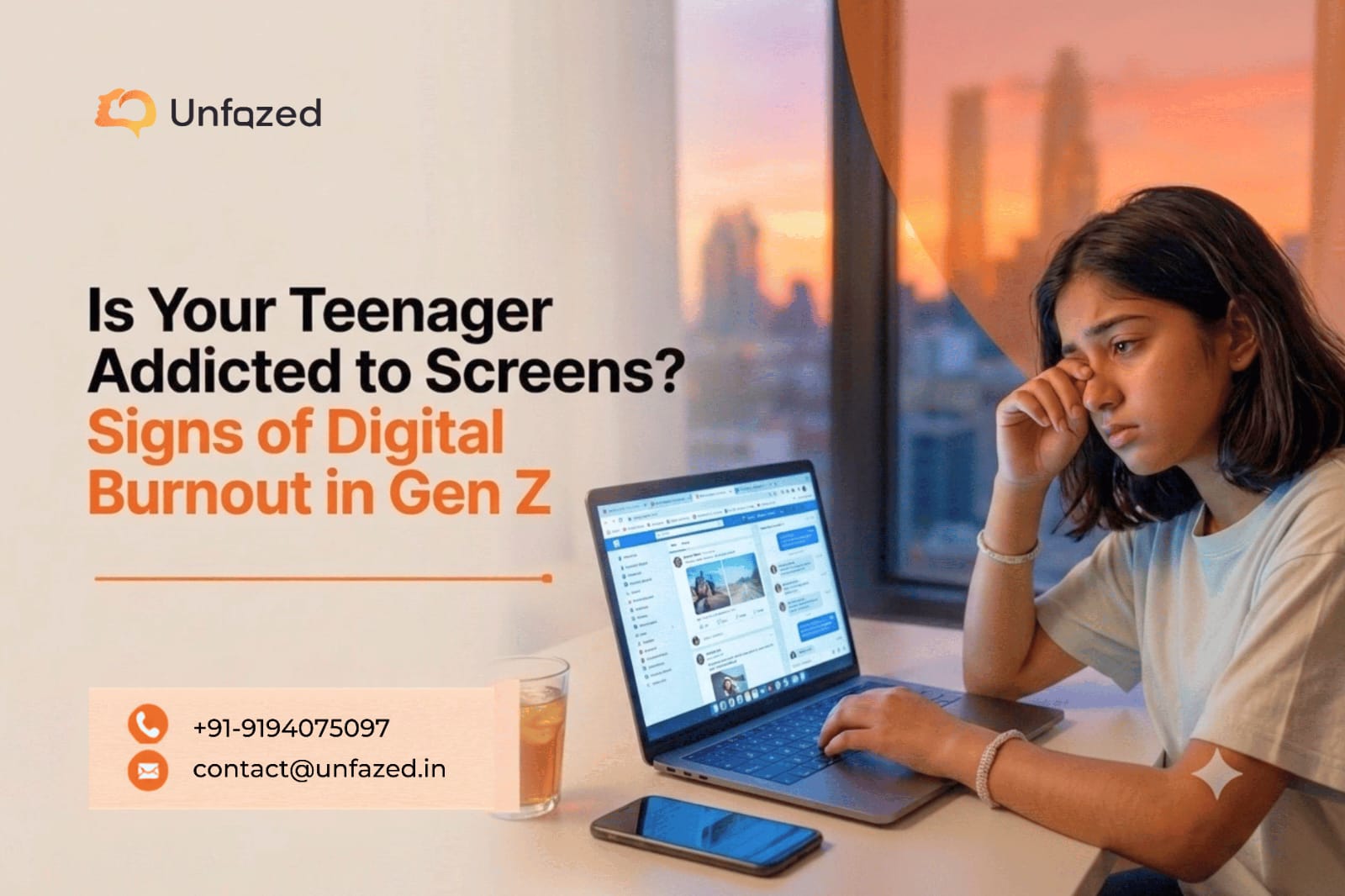
Is Your Teenager Showing Signs of Screen Addiction? Understanding Digital Burnout in Gen Z
It is 11:00 PM in a typical household in Bangalore or Delhi. The lights are off, but a familiar blue glow emanates from beneath a bedroom door. Inside, a teenager is scrolling through Instagram Reels, playing an intensive round of Valorant, or responding to a flurry of Snapchat notifications. For many parents, screen addiction in teens, this is a nightly battle.
For Generation Z, technology is not a tool; it is the environment they inhabit. However, when the “digital environment” begins to eclipse physical reality, academic responsibilities, and emotional stability, we move into the territory of screen addiction in teens.
As digital natives, teenagers are increasingly susceptible to digital burnout—a state of mental and physical exhaustion caused by prolonged, compulsive technology use. At Unfazed.in, our mission is to help families navigate these modern hurdles by providing access to licensed child psychologists and teen counsellors who specialise in adolescent digital wellbeing.
What Is Screen Addiction?
Clinical psychology often refers to screen addiction as “Problematic Interactive Media Use” (PIMU) or “Disordered Interactive Media Use.” While the DSM-5 specifically recognises “Internet Gaming Disorder,” the broader concept of screen addiction encompasses social media, streaming, and general smartphone overuse.
It is not defined solely by the number of hours spent online, but by the relationship the teenager has with the device. Screen addiction in teens occurs when the drive to use technology becomes compulsive, leading to significant impairment in daily functioning, social relationships, and emotional health.
Why Teenagers Are More Vulnerable Than Ever
The adolescent brain is a work in progress. The prefrontal cortex—the area responsible for impulse control, decision-making, and long-term planning—does not fully develop until the mid-twenties. Meanwhile, the brain’s reward system (the limbic system) is hyper-reactive during the teen years.
Apps and games are engineered with “persuasive design” techniques—such as infinite scrolls, “likes,” and variable reward schedules—that trigger dopamine releases. For a teenager, the surge of dopamine from a social media notification is far more powerful than the abstract satisfaction of finishing homework. This biological vulnerability, combined with the Gen Z need for social belonging, creates a perfect storm for technology addiction in teens.
10 Warning Signs of Screen Addiction in Teens
Recognising screen addiction symptoms requires parents to look beyond the screen time counter. Here are the 10 red flags:
1. Preoccupation and “Mental Enmeshment”
Even when the device is away, the teen seems distracted, talking only about their online world. This happens because the brain is constantly anticipating the next digital reward.
- Real-Life Example: Your teen is at a family dinner in Pune but is visibly anxious to get back to their room to check a “live event” in a game.
2. Withdrawal Symptoms
When denied access to their device, the teen exhibits irritability, anxiety, or even physical aggression. This is a physiological response similar to chemical withdrawal.
- Seek Help If: The teen becomes verbally or physically abusive when a “digital sunset” is enforced.
3. Tolerance: The “More” Factor
Just as with other addictions, teens develop a tolerance. They need more time on higher-intensity platforms to achieve the same “high” or sense of satisfaction.
4. Loss of Control and Failed Attempts to Quit
The teenager expresses a desire to cut back but finds themselves “mindlessly” picking up the phone again. This indicates an executive function deficit caused by technology overuse.
5. Loss of Interest in Previous Hobbies
Activities that once sparked joy—football, music, or hanging out with friends in person—are discarded in favour of screen time. This is a primary indicator of digital burnout.
6. Use Despite Negative Consequences
Despite failing grades, lack of sleep, or strained family ties, the teenager continues the same pattern of use.
- Psychological Explanation: The “bottom-up” reward system has completely bypassed the “top-down” reasoning of the prefrontal cortex.
7. Deception and Hiding Use
Teens may begin “smuggling” devices into bed or lying about what they were doing online. This secrecy is a hallmark of internet addiction.
8. Escape and Mood Regulation
Using the screen to avoid dealing with real-life problems like anxiety in teenagers or social rejection. While it feels like a coping mechanism, it is actually “maladaptive avoidant coping.”
9. Risking Opportunities and Relationships
Missing classes, skipping meals, or neglecting hygiene to stay online. In a teen counsellor Mumbai session, we often see this as the point where “functioning” stops.
10. Digital Burnout and Emotional Volatility
A teen who is constantly “on” never allows their nervous system to enter a state of rest. This leads to digital burnout in teenagers, manifested as chronic fatigue, low empathy, and heightened depression in teenagers.
Digital Burnout vs Healthy Screen Use
It is vital to distinguish between a teen who uses technology for school and socialising and one who is suffering from digital burnout.
| Feature | Healthy Screen Use | Screen Addiction in Teens |
| Purpose | Intentional (homework, specific chat). | Compulsive/Mindless scrolling. |
| Control | Can stop easily when asked. | Intense distress/rage when stopped. |
| Social Life | Uses tech to enhance real-life bonds. | Uses tech to replace real-life bonds. |
| Hobbies | Maintains a variety of offline interests. | Offline interests have disappeared. |
| Mood | Generally stable; tech is a minor part. | Depressed or anxious when offline. |
| Sleep | Sleep is prioritised over gaming/scrolling. | Chronic sleep deprivation; “Vamping.” (using devices secretly at night) |
| Academics | Grades are consistent with ability. | Sudden, unexplained academic decline. |
| Honesty | Transparent about online activities. | Deceptive; hides devices or history. |
How Excessive Screen Time Affects Teen Mental Health
The link between excessive screen time and adolescent mental health is well-documented by the American Psychological Association (APA).
- Anxiety and Depression: Social media often fuels the “compare and despair” cycle. For a teen in Delhi or Bangalore, seeing the curated lives of others can lead to a sense of inadequacy and anxiety in teenagers.
- The Sleep Crisis: The “blue light” emitted by screens suppresses melatonin. Furthermore, the high-arousal content of gaming prevents the brain from entering deep sleep, leading to a vicious cycle of fatigue and digital burnout.
- Attention and Focus: Constant multitasking on screens shrinks the “attention span,” making deep work and academic focus nearly impossible.
How Parents Can Reduce Screen Addiction
We recommend a “Mentor, not Policeman” approach.
- Establish a Digital Sunset: All devices go into a common charging station 60 minutes before bed.
- Create “Tech-Free Zones”: The dining table and bedrooms should be sacred spaces for human connection.
- Encourage “Dopamine-Friendly” Offline Tasks: Help your teen find high-reward offline activities, like sports or learning an instrument, to satisfy the brain’s need for stimulation.
- Model Healthy Behaviour: If you are constantly checking your phone, your teen will view your “rules” as hypocritical.
- Use the “Screen Addiction Test”: Use reputable online tools or clinical questionnaires to assess the severity together.
When Should Parents Seek Professional Help?
If your teenager is showing five or more of the 10 warning signs listed above, or if your attempts to manage screen time result in explosive conflict, it is time to consult an adolescent psychologist.
Early intervention is the key to treating screen addiction in teens. Unmanaged addiction often masks underlying issues like ADHD, social anxiety, or trauma.
How Unfazed’s Licensed Psychologists Help Teenagers
At Unfazed.in, we provide a holistic, evidence-based approach to adolescent mental health. We understand the unique cultural pressures of the Indian urban landscape—from the academic rigour in Bangalore to the social competition in Mumbai.
- Teen Counselling: Our therapists use Cognitive Behavioural Therapy (CBT) to help teens recognise their triggers and rebuild self-regulation.
- Parenting Counselling: We empower parents to set boundaries without damaging the parent-child bond.
- Family Therapy: Often, screen addiction is a symptom of a communication gap within the family. We help bridge that gap.
- Digital Habit Coaching: We work with the teen to create a sustainable “digital diet” that allows for both technology and real-life growth.
Healthy Technology Habits for the Whole Family
Healing from screen addiction in teens is a family journey. By fostering a culture of digital wellbeing, you ensure that technology remains a servant to your family’s goals, not the master.
Remember, the goal is not to “ban” technology—that is impossible in 2026. The goal is to build a healthy mind that is capable of living a full, vibrant life both on and off the screen.
Is the Screen Glowing Brighter Than Your Teenager’s Future?
Don’t wait for digital burnout to become a clinical crisis. If your teenager is struggling to unplug, we are here to help.
At Unfazed.in, we connect you with compassionate, licensed child psychologists and teen counsellors who understand the Gen Z world.
Reclaim your family’s connection today.
Book your Discovery Call for just ₹299.
Website: www.unfazed.in
E-mail: contact@unfazed.in
Book Your First Session with Unfazed Today. Call us @ +91-9194075097
Medical Disclaimer: This article is for educational purposes only and does not replace a professional mental health assessment, diagnosis, or treatment.
FAQ’s:
It is normal for Gen Z to use technology for several hours. However, it becomes an addiction when they cannot stop, experience withdrawal (rage/anxiety), neglect physical health, or lie about their use. If screen time is interfering with their ability to function, it is likely screen addiction.
What are the signs of screen addiction?
Key screen addiction symptoms include preoccupation with the device, failed attempts to cut back, loss of interest in offline hobbies, and using screens to escape from reality. Physical signs include chronic fatigue and sleep disturbances.
How much screen time is too much for a teenager?
There is no “magic number,” but the American Academy of Pediatrics suggests that screen time should not come at the expense of 8-10 hours of sleep, physical activity, and face-to-face socialising.
Can screen addiction cause depression in teenagers?
Yes. Studies show a significant correlation between excessive screen time and increased rates of depression in teenagers. Social isolation and the “comparison trap” on social media are major contributors.
Is there a screen addiction test for kids?
Yes, psychologists use tools like the Internet Addiction Test (IAT) adapted for adolescents. At Unfazed, we offer clinical assessments to determine the severity of your child’s technology use.
Can therapy help with screen addiction treatment?
Absolutely. Screen addiction treatment often involves Cognitive Behavioural Therapy (CBT) to rewire the brain’s reward pathways and family therapy to improve offline communication.
How do I find a child psychologist Bangalore or teen counsellor Mumbai?
You can easily connect with a child psychologist near me or a teen therapist online through Unfazed.in. We offer virtual sessions that fit into your teen’s schedule, ensuring expert care across India.
Why is my teen so aggressive when I take the phone away?
This is a sign of a “dopamine crash.” The brain has become dependent on the high-intensity stimulation of the screen, and removing it causes an immediate stress response in the nervous system.